Standardizing the ERP Landscape for Paper and Board: Case Study at Beaver Paper
Whether clothing, furniture, packaging, or household goods, almost any polyester fabric or any hard surface, including corrugated and packaging substrates, can be sublimated with a polyester coating. The result is a permanent, high-resolution full color print. With 40 years of experience, Beaver Paper offers the most comprehensive product portfolio of sublimation media for use in a variety of applications. Its products are available in more than 51 countries worldwide.
Five years ago, Beaver Paper was acquired by the Koehler Paper Group from Oberkirch, Germany. The acquisition was meant to represent an opportunity to pool the expertise of two global leaders in their sectors of the industry; however, the takeover was also accompanied by media disruptions between the locations in Germany and America. For a long time, two different—and in some cases, outdated—ERP systems with different user interfaces were in use.
Each system was very specifically geared towards its respective local requirements. This had a particularly detrimental effect on accounting and controlling. Many tasks had to be carried out manually, which led to errors and delays in the process—for example, during month-end closing. In addition, there was no overview of the entire company.
CREATING A GLOBAL STANDARD
In 2022, the company therefore opted for a globally integrated ERP landscape, known as an Intelligent Suite, across all locations. The focus was on a clean-core strategy and the ability to “map” the entire business. The idea behind the change: By standardizing processes and data underlying ERP operations, companies can better leverage best practices and make targeted adjustments where differentiation from other providers is desired. All business-critical applications, such as production planning, production itself, and logistics, are mapped in the core; while specific use cases, such as automatic test lanes or computer-aided design, are mapped using special software.
This means that fewer software adaptations are necessary, central business processes are automated, the database size is smaller, and innovations are possible more quickly. In the long term, companies benefit from a simplified, more flexible, and faster system.
BRIDGING THE GAP BETWEEN TWO CONTINENTS
The company was looking for software with a robust, resilient, and secure core that could be expanded. “Not everything that the Koehler Paper Group needed was initially relevant for Beaver Paper, but we still wanted to keep our options open,” says Tobias Sternbeck, CEO at Beaver Paper. “For these reasons, the decision was made in favor of SAP and the Business Technology Platform as the basis.” For the implementation, the company chose the SAP full-service provider T.CON, which was founded in Germany and has been supporting the Beaver Paper for many years.
For more than 25 years, T.CON has been passionate about digitalizing the corrugated, pulp, and paper industries. As an SAP Gold Partner, T.CON links up processes, systems and people and rethinks business processes. A digital transformation with SAP and SAP-based solutions offers enormous potential to increase the performance of corrugated and paper manufacturers alike. For T.CON and Beaver Paper, one challenge in the ten-week planning process was to align with Kohler’s existing system while customizing functions to meet the different business requirements. “We had to create a link between a classic rollout and a conversion to ‘greenfield’. To do this, we developed a ‘delta architecture’ in workshops and approached the topic from the user’s perspective,” says Andreas Zollner, business lead, production & MES, at T.CON.
The team began by conducting a case study and analyzing the current system landscape, processes, and applications on site in the US. It then identified gaps in the system and defined features for business areas such as accounting, procurement, sales, logistics, warehousing, and quality management. “Two aspects were important to us: retaining well-functioning processes; and transferring business-critical processes to SAP, but running smaller applications via Excel, for example,” explains Zollner.
KEEPING THE CORE CLEAN
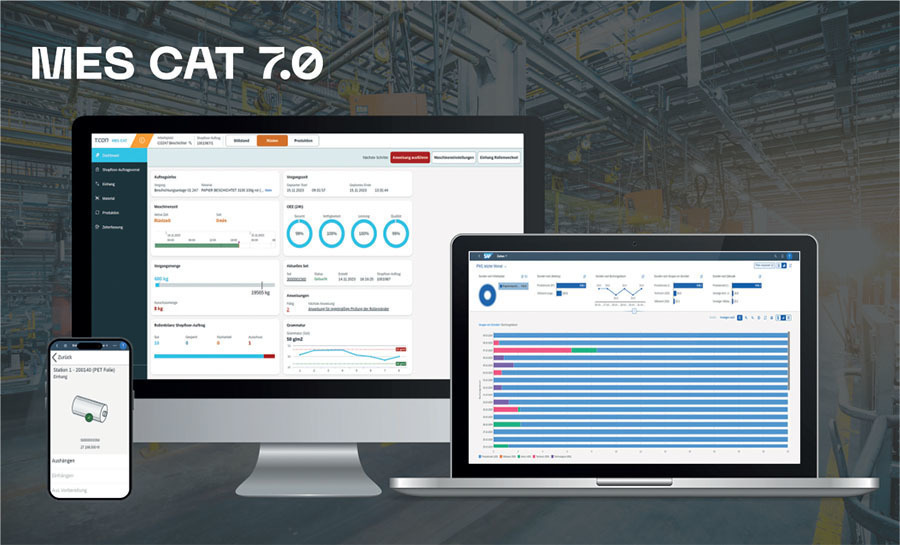
The directly integrated add-ons included the SAP Advanced Demand Planning and Supply Chain Optimization tool for sales and procurement planning, MES CAT, a manufacturing execution system developed by T.CON for the digitalization of production; and SAP Extended Warehouse Management for warehouse management. Production-critical components such as the entire machine park, autonomous tugger trains, and conveyor belts—which must also be available offline—were integrated separately to be able to maintain the ERP system without affecting production and warehouse management.
Tools that were connected externally alongside SAP S/4HANA included the database management systems Microsoft SQL Server, MongoDB, and InfluxDB. Says Zollner, “We wanted to take advantage of these technologies, but keep the core of the system ‘clean’ in order to increase responsiveness, be able to expand it quickly, and easily test innovations.” To reduce silos, the team also attached great importance to seamless end-to-end processes with as few interfaces as possible.
CONSIDER COUNTRY AND MARKET SPECIFICS
Based on this architecture, the team drew up a 12-month roadmap for an iterative approach from the implementation of the system to user acceptance tests, training, and go-live. The individual phases were continuously monitored in terms of time, quality, and budget. Among other things, the team on site transferred 40,000 handling units to Extended Warehouse Management and relabeled them in real time. It also integrated more than 20 machines with a production depth of seven material levels. Both are (time) critical measures that result in largely fully automated production. Machine operators are relieved of any manual tasks and can concentrate on the essentials: registering and setting up the machine.
Project management with workshops at Beaver Paper US headquarters in Lawrenceville, GA, was a key factor in the project’s success. Not only were clear objectives and a binding framework jointly developed, but a close, trusting relationship was also established between the culturally and linguistically very diverse teams in Germany and America. “At the start of the project, mills should pay attention to market- and country-specific issues, and consult experts if necessary. For example, when it comes to different uniform systems that cannot be harmonized or different tax systems,” says Sternbeck. The regular virtual coordination meetings, the fast pace at which decisions were made, and the continuous measurement of interim targets were also important. Intensive training sessions (based on the train-the-trainer principle) ensured that first, the key users from the various departments, and then the end users, were able to master the new solution—and the changes that came with it. They also helped keep motivation high. It was crucial not to hold the training courses too early—only two weeks before the go-live—so that users could get straight into the productive system with fresh knowledge.
Change management and change communication were critical to pull everyone together on the journey, accept initial application errors, and overcome technical hurdles such as cybersecurity and secure network communication between the locations. “A reliable implementation partner is also recommended,” says Steinbeck. “Not only during the course of the project, but also afterwards when it comes to user requests and maintenance work.”
The next step for Beaver Paper is to take a holistic approach to increasing the level of digital maturity in the direction of Industry 4.0. The Digital Maturity Model provides guidance here. Together with T.CON, the company plans to further optimize its processes and make them more efficient. The team also wants to bring the various systems up to date, to reap the most benefit from additional functions and state-of-the-art technologies. The focus is also on automating the shop floor in the areas of packaging and transportation, through the use of robotics.