Pulp and Paper Machine Healthcare, Part 2: Condition Monitoring of the PM and Auxiliary Machines

Reel section of the paper machine. Faulty bearings on a roll or cylinder can affect paper quality, so it is important to detect the fault before this happens. ISTOCK.COM/DEDMITYAY
As the pulp and paper (P&P) industry continues to expand and becomes digitalized, papermakers should remain focused on the healthy functioning of the myriad machines involved in the pulp and papermaking processes. This is true not only for the machines directly involved, but also for the numerous pieces of auxiliary equipment crucial for power production, steam generation, and wastewater treatment. These machines face greater operation and maintenance challenges than ever, but interest in monitoring them is still low.
INCREASED REQUIREMENTS
Today, mills are paying more attention to monitoring machines, due to business pressures and a change in the way the machines are operated and maintained. They are being operated at higher speeds, for longer periods of time between shutdowns, under variable operating conditions with faster turn-around time, and in many cases under harsher operating conditions. This results in the machines being stressed more than they were originally designed for.
In addition, the same machines must be operated more efficiently, with increased safety and higher quality requirements, and with less spare inventory, diagnostic manpower, and maintenance resources to look after them.
MACHINE MONITORING TODAY
Although the paper machine is the heart of the papermaking process and the single largest capital investment in the P&P mill, it often receives very little “healthcare” attention, despite the fact that maintenance can have a huge impact on its life cycle costs. Moreover, even less or no attention is given to the mill’s hundreds of auxiliary machines. Obviously, the cost of taking care of a single auxiliary machine is not much, but the entire fleet of these machines significantly impacts maintenance resources.
This article briefly looks at the potential failure modes of P&P machines in the following three processes: pulping; power production, steam production, and wastewater treatment; and papermaking. Below, we list machines used in each process and sub-process and note a critical maintenance challenge that can be addressed through condition monitoring.
PULPING PROCESS
Many of the larger machines are ageing with no readily available replacement parts.
Wood processing:
- Debarker, chipper—A bearing failure can result in a catastrophic failure, which means up to a week of downtime. If there has been damage to the chipper disc because of a bearing failure, this can also reduce its remaining useful life.
- Belt conveyors—The motor and gearbox are heavily loaded and may require special monitoring techniques to filter out the high noise to detect faults.
Pulp production:
- Mechanical pulpers—If the grinding wheel bearings fail in the harsh environment, the pulping process stops.
- Chemical digester pulp scraper—These machines often have a pulp scraper at the bottom of the digester; scrapers are under heavy load and can fail unpredictably.
- Chemical digester pumps—There are several pumps for the white, black, and green liquor caustic chemicals used in the chemical digester, both for delivering the chemicals and for their recovery. Pulping also uses a lot of water, so failed water pumps will stop the process.
- Waste paper preparation machines—The de-inking process for wastepaper pulping also uses pumps. Other machines include desanders, which operate under harsh, variable load conditions.
- Blow tank—The agitator inside can fail unpredictably.
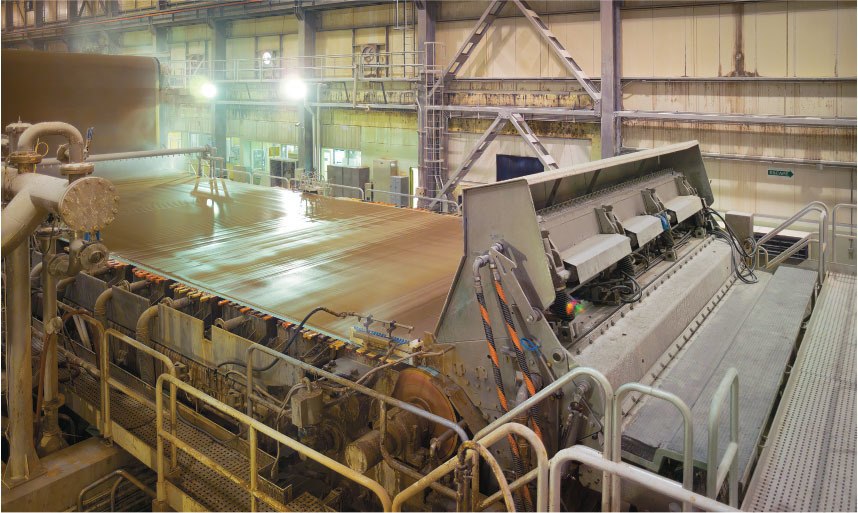 Paper machine forming section. Online monitoring systems must be tailored for harsh mill conditions, including high temperatures and humidity. ISTOCK.COM/TIFONIMAGES
Pulp refining:
- Refiner—These hydraulic refining machines use high-speed rotating discs to process the pumped-in pulp slurry. All of them include rotating shafts supported by bearings, which are heavily loaded.
Pulp screening, washing, and bleaching:
- Screening—The gearbox and bearings for turning the screen cylinder are heavily loaded, and the load varies.
- Pulp washer—Several pumps are used in the pulp washing process. If they fail, this could lead to a shutdown.
- Disc filter—This is normally a low-speed application typically driven by a four-stage gearbox and a motor. Vacuum pumps are sometimes used in the disc filter together with clear filtrate pumps. If the disc filter or pumps stop, so does the pulp cleaning process.
- Wash press—The roll bearings are subjected to higher loads than the other pulp washing machines. A malfunction can result in a complete production stop for several days.
- Bleaching tower—The discharge scraper at the bottom of the tank is susceptible to unpredictable failure. The bleaching tower also uses centrifugal blowers for chemical laden airstream.
- Screw conveyor—The motor and gearbox are important components, but the hanger bearing fails most often because of the special loading.
POWER PRODUCTION, STEAM PRODUCTION, AND WASTEWATER TREATMENT
P&P production requires a great deal of power, water and steam.
- Turbo-generating units for power and steam production—These should be monitored in the P&P mill as is normally done in power stations.
- Wastewater, ventilation, chemicals, and wood byproduct management—Many pumps and fans are used here. Due to sustainability policies and strategies, this equipment has become a top priority from a condition monitoring point of view. If not operating properly, the mill might be fully shut down.
PAPERMAKING PROCESS
This includes:
- Forming section (wire section)
- Press section
- Drying section
- Calender section
- Reel and winder section
Forming section:
If there is an upgrade to run faster, sometimes a top wire is added.
- Headbox injectors—Just one faulty compressed air injector is enough to affect paper quality and would require a shutdown.
- Vacuum system—Liquid-ring vacuum pump repair can be costly: up to US$150,000. Failure of a vacuum pump may lead to speed reduction or even shutdown.
- Fan pump and other pumps—If the fan pump for the pulp stock stops, the entire paper machine must stop. Stones or other abrasive matter can damage the impeller and unwanted pulsation pressure can affect the consistency of the paper web. Filler chemicals can further stress the pump. Various pumps used in the forming section—for example, clarified water pumps from the save-all system—can also fail.
- Rolls—Although the rolls in the forming section are not as stressed as those in other parts of the paper machine, they are still critical to the process. The bearings are subjected to high humidity and water; if they fail, the entire paper machine stops. In addition to the bearings, the gearbox and motor should also be monitored.
- Vacuum pumps—If they stop, this may require a partial or total stop of the entire paper machine.
- Wire—This is typically not monitored directly, but wire faults can still be detected between the rolls in a top wire application. This is done using accelerometers on the roll bearing housing at both ends.
- Lubrication pumps—Lubrication pump system failure can affect between 1,000 to 1,500 bearings. Lubricant can be contaminated with water and impurities.
Press section:
The press section is critical. If not enough water is removed due to faulty components, then more steam is needed in the drying section to compensate. This requires more energy and thermally stresses the drying section components.
- Press rolls—The nip pressure stresses the bearings, especially in the later press sections. In addition to the risk of overloading, the bearings can be further stressed due to uneven wear; felt problems; and roll misalignment, eccentricity, and imbalance. There can also be roll bouncing, vibration, and roll resonance that result in barring quality issues for the paper.
- Felt and felt rolls—A defective felt will affect the nip load on the rolls and this can be detected from the bearing housing accelerometer. There can also be vibration impacts due to uneven felt runnability issues. A change in the felt’s natural frequency could signify the felt is clogged or over-compressed.
- Vacuum pumps—If the vacuum pumps stop working, this will affect the press section dewatering process. If not corrected, this could require more steam in the drying section, which will stress components.
- Pressure cleaner and water spray pumps—Although not as critical as the fan pump or vacuum pumps, paper quality issues can occur if these pumps are defective.
Drying section:
Machine component faults often occur here.
- Hood heat recovery—Ventilation fans prevent heat and humidity from spreading to the machine hall. If they fail, this can create an unsafe work environment.
- Steam and condensate system—If the condensate pumps and vacuum pumps stop working, the paper will not be properly dried.
- Cylinders and Yankee dryer—The cylinders and bearings are subject to thermal stress. If the paper machine is upgraded to run faster, this could further stress the components as more heat would be needed to compensate for less dwell time.
- Cylinder steam—If the fans and pumps that provide steam stop, so does the steam flow. Condensation pumps are also vulnerable in the process.
- Air blowers and steam exhaust fans—If the air blowers and exhaust fans stop working, the drying section will need to stop.
- Felt and felt rolls—These are similar to the press section felt rolls but are subjected to much more heat.
- Size press—These rolls are subjected to contamination (dyes, starch) and, if they fail, the paper machine stops.
- Coating pumps—Pumps for chemical treatment of the paper are subject to contamination and, if stopped, the paper machine also must be stopped.
Coating, calender, and reeling section:
- Coating kitchen machines—If the pumps and blades here are defective, the paper product that was produced must be rejected and production cannot continue until the machines are fixed.
- Reel drum—These bearings are heavily loaded. Though they’re not subjected to humidity and high temperatures as in other sections, there is still dust. This machine is slow turning and therefore requires a special monitoring technique to detect bearing faults.
- Calender section—The nip loads stress the bearings, which are also subject to dust contamination. Much like the press rolls, paper quality variation could be caused by forced vibrations such as roll surface defects, imbalance, misalignment, or eccentricity. There can also be barring resonance vibration between the rolls caused by selfexcited resonance of the roll stack, which can be monitored.
- Reel and winder section—The bearing load on the reel spool is very high and there is risk for dust contamination. Defective bearings could affect the quality of the paper being reeled. There is less load on the winder spool bearings, but the failure modes are the same as for the reel spool.
- Finished product sizing—There are several machines in this process, such as sheeters, slitters, winders, and rewinders, where components can fail.
MONITORING SOLUTIONS
Nearly all the machines mentioned in this article can be monitored by one of the following monitoring solutions or a combination of them:
- Off-premises, cloud-based solution—This proprietary, stand-alone monitoring solution is ideal for balance-of-plant machinery where there is limited in-house diagnostic expertise. Only wireless sensors and a gateway are installed onsite, while all data storage, signal processing, monitoring, diagnostics, and reporting is done remotely. The user can access reports remotely and, if needed, also the data and plots.
- On-premises, field monitoring solution—Also for balance-of-plant machinery, this solution offers more condition monitoring functionality. Data storage, monitoring, diagnostics, event notification, visualization, and analytics can be done in the historian or remotely as a service.
- On-premises, rack-based monitoring solution—This solution includes advanced machine condition monitoring functionality for critical machines, including machine protection. The system can be integrated into the historian and/or accessed by remote services.
CONCLUSION
There are many critical and balance-of-plant machines in a P&P mill, and the way their operation and maintenance are managed could affect profitability. Although many mills understand the need to monitor at least certain sections of the paper machine, many other machines are completely ignored—even though they can still affect paper quality, paper waste, production, safety, energy savings, and working conditions. Fortunately, many of these can be cost-effectively monitored.
Machine condition monitoring solutions have evolved since our industry’s digital transformation, so on site proprietary stand-alone monitoring systems are no longer the only solution. Today, a wide range of on-premises and off premises systems can be combined, and much of these can be integrated into the enterprise wide data management system. This enables service providers to more effectively share their expertise with the centralized data. Monitoring techniques have also been improved and now there are AI and machine learning algorithms to further improve machine healthcare insight.
To support the end-user, a site survey can be conducted to find the ideal monitoring solution.
Look for Part 1 of this series in the Trendspotting section of our March/April issue, where the author presented cost-effective digitalization solutions for condition monitoring.